Showing posts with label growing up. Show all posts

Friday, December 20, 2013

Flying Along with Desmond and Molly


The other day I was working on a quilt--for hours--and listening to the White Album, the Beatles album that came out my freshman year of college.  That music was everywhere then.  We used to jump on our dorm beds to "Ob-La-Di, Ob-La-Da."

I began to wonder what in hell happened to the girls I met that year, who lived in the same dorm hall:  Betsy,  Rockie, Barbara, Nancy.  I'm in touch with my roommate of that year every Christmas, but these other people had become phantoms.

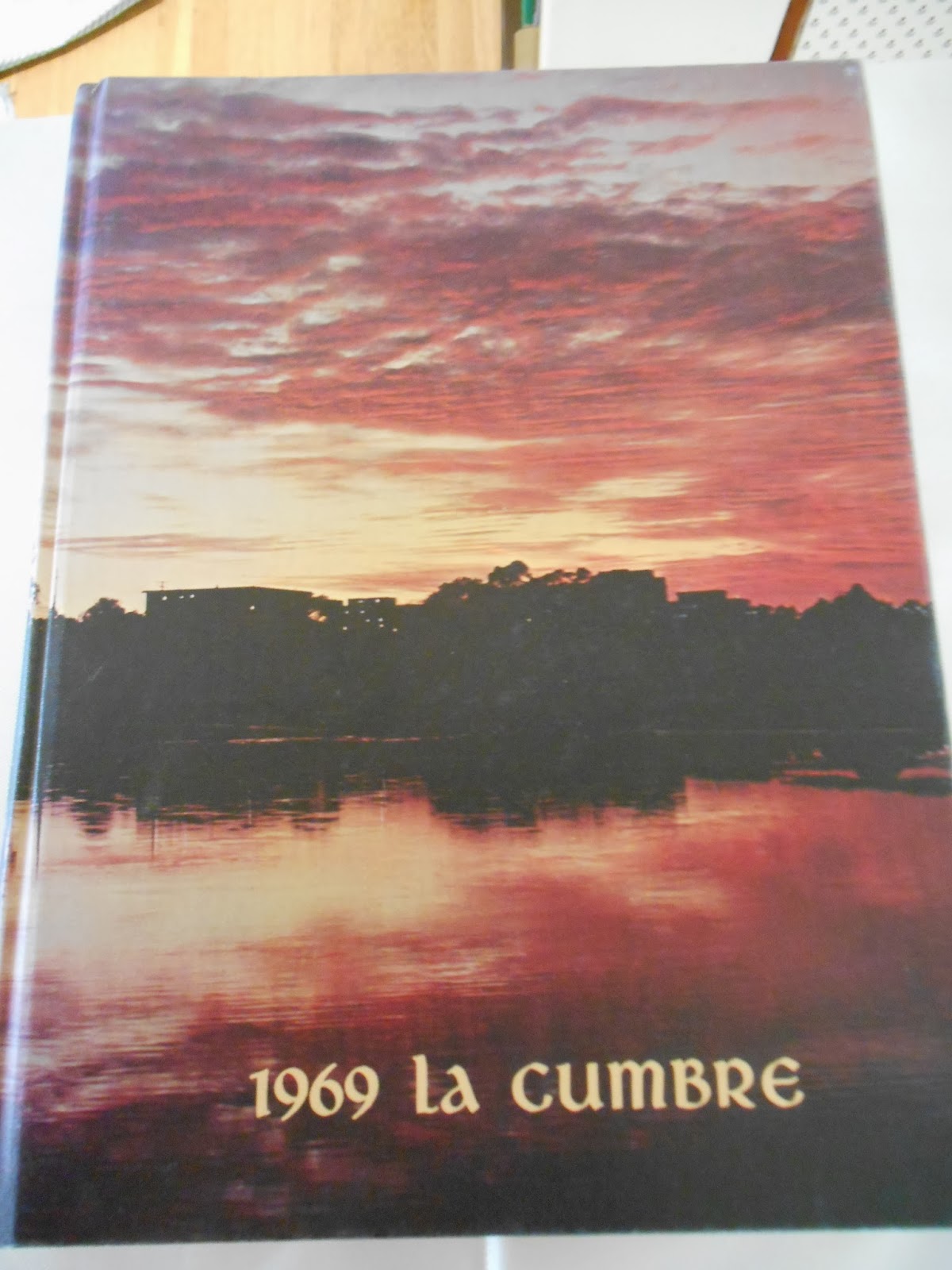
I got out the 1969 UCSB yearbook and looked at our group picture:


My then-friends, all in the front row:  Nancy (third from left), Rockie, Betsy, and  Barbara on the far right.  I'm in the back row, third from right, wearing a scratchy wool Villager dress

Why is everyone wearing plaid? Why are we all wearing skirts, for that matter?  But then that was was a dorm with door-less "date rooms," where at least one person had to have his/her feet on the floor at all times.  We also had a housemother and a curfew and lock-out.

I got so wound up on the White Album, flying on caffeine from a bar of TJ's chocolate,  that I turned on the computer and looked for one of these girls on Facebook, the only one whose married name I knew:  Betsy.  She responded:

"OMG Liz Randal!  Where have you been?"  Like I just stepped out for a minute and forgot to come back.

Her former roommate, Rockie, saw that on FB, and jumped into the conversation.

So!  They're still funny, irreverent, and Democrats.  Rockie even quilts.  Barbara's a portfolio manager in LA,  Rockie's living in New Mexico, Betsy in San Jose, and Nancy is lost somewhere. 

UCSB in 1969
That White-Album winter, we endured forty days and forty nights of rain.  Our bicycles rusted sitting out under eucalyptus trees. We were cooped up in rooms with highly polished linoleum floors and heavy doors that slammed at all hours.  Every bathroom had a can of solvent to get beach tar off our feet.  I transferred to Berkeley my junior year and lost touch.

It's been comforting to find out that these friends went on to become Regular People.  Part of me has always felt that I was less accomplished, surely, than that group of girls with diamond-sharp minds and big dreams.  Not so.   None is Shakespeare or a Princeton professor or a Bill Gates. Most married and had children.  Some were employed.  Some got graduate degrees.  Most seem to be enjoying their lives.

And anyway, who cares?  At 63, it's good enough just to be alive and finding some fun (okay, joy occasionally) in each day.  You have to live to be a certain age to appreciate that.  And this life is so much more restful.


'

Wednesday, February 13, 2013

Pox on the Pope? But Not on His People


Yesterday I read an op-ed in the New York Times about Pope Benedict XVI that was so astoundingly blunt that I interrupted Jerry's breakfast read of Sports Illustrated to make him listen to it. (I'm struggling with learning "links" but you can find it in the NYT list of most-e-mailed articles.)

The playwright John Patrick Shanley took the pope and the Roman Catholic Church to task unrelentingly, in a "no-good-can-come-of it" kind of way, as in  "the church is doomed due its intransigent intolerance."

I've never been a Catholic, and I disagree strongly with the Church's stand on homosexuality, birth control, abortion, celibacy, and a men-only priesthood. I'm baffled by the fact that infertile Catholics are not allowed to use IVF.  Nevertheless, I don't like to see the entire Church, which is, after all, people, dissed.

Ancient and out of touch?

I think there are many rank-and-file American Catholics who find spiritual sustenance in their church, who abhor the cover-up of pedophilia, who give money and time to catholic charities and hospitals.  Many disagree with the Church's teachings on social issues and have found ways to circumvent them in their own lives.

I used to be baffled by this "hypocrisy," but now, after months of reading blogs by young Catholic women, I'm more tolerant.

And then there are the Concello girls.

When we were growing up, my sister and I were best friends with the three of them, who lived over the fence from us.  They belonged to St. Martin's Catholic Church, and they had lots of mysterious things they had to do: catechism, confession, diping their fingers in holy water, not eating meat on Fridays.   I remember thinking, whoa,  complicated!

I haven't seen any of the Concellos in years, and I hope to God they didn't campaign against Proposition 8 or go harass people outside Planned Parenthood.  But I respect their attachment to a religion they were born into, that may have enriched their lives in a very personal way that circumvents a pack of men in Rome who are woefully out of touch, intolerant, and unkind. 

Backyard birthday party with the Concello girls, c. 1959.  Front row, left to right: me, Valerie and Vicky Concello, my sister with her hand being held up by Michele Concello.  Best friends through elementary school.


Thursday, November 29, 2012

Soggy Weekend


It's winding up to rain big time in the Bay Area (hysterical weather people predict a "fire hose" and a "deluge").  Here's a recommendation for a good read.


I loved this book!  If you went to college and faced a big turbulent scary void when you graduated, didn't know where you were going to live, where you'd find a job, whether you'd ever find a boyfriend/girlfriend, where you'd go to graduate school or if--this book evokes that time  so thoroughly that I thanked God several times that I'm old. 

A girl, two guys, all brand-new graduates of Brown University, Class of 1982,  try to find their way, their lives intersecting romantically and intellectually.  I thought the writing was wonderful, the descriptions so apt, but not over-the-top.  Here's a sample:

"Beyond the bay window of Carr House, the graduation traffic was now steady.  Roomy parental vehicles (Cadillacs and S-Class Mercedeses, along with the occasional Chrysler New Yorker or Pontiac Bonneville) were making their way from the downtown hotels up College Hill for the ceremony.  At the wheel of each car was a father, solid-looking and determined..."

Roomy parental vehicles!  Solid-looking fathers!

Below is  a photo taken the day I graduated from Berkeley wearing a home-made, flame-colored dress.  I was full of book-learning and a baby in Life.  Several bummers followed.


Graduation lunch, June 17, 1972.  Claudia, Debbie, my sister, my mother, and me.


Monday, October 22, 2012

Hupmobiles, Kaisers, and Other Family Cars


Sorting through the stash of family photos I inherited when my parents died,  I came across lots of pictures of really old cars.

My parents' first car was Hupmobile.   It looks like something out of a gangster movie. It had a running board. Here I am with my mother and the Hupmobile, in front of my grandparents' house in Oakland in 1952:


Note running board (no machine guns)


A close-up of the hood ornament on this baby:


What is it?

A look online:  Hupmobiles were named after Robert Hupp, who founded the company in 1908; production was suspended in 1939.  I think my parents bought theirs in the early 1950's.

After a few years,  my dad got rid of the Hupmobile (he was in charge of car acquisition, and for years my mother didn't drive), and bought a Kaiser.  I ran this past Jerry.  A Kaiser?  "Oh, they were losers," he said.  "People made jokes about them."

Turns out they were produced by Kaiser Industries from 1945 until 1953, when Kaiser could no longer compete with GM, Ford, and Chrysler.  Among the model names: Carolina, Traveler, Dragon, and Manhattan.

Here we in Santa Cruz,  c. 1955, with our Kaiser, which was sort of a dried-blood color:

My mother, my sister, and I with our Kaiser


Not a very good shot of the car, but here's what a similar model looked like:


With bench seats:

No seat belts, but my sister and I survived to adulthood

A few more years,  and my dad traded in the Kaiser for a brand-new 1959 Ford.

My sister and me with bikes, two-toned car, and tract house, c. 1960


This tank cruised on for ages.  My sister drove it to high school, and it didn't bite the dust until the early 1970's when she and her friend Margaret were broad-sided by a teenage boy who ran a stop sign.  They were unharmed

I'm amazed at how many photos there are of the family standing next to the car of the moment.  That ended with the Ford.  After that, there are no people-and-car shots, although my parents had several other cars over the decades.

The last car, which my sister and I sold when our dad died, was a Volvo station wagon.  All white.  No photos.


Friday, October 19, 2012

Religious Education and Me

Yesterday I read an article in the latest New Yorker about the Book of Common Prayer, now 350 years old.

I call myself a lapsed Episcopalian, but the quotations from the Book of Common prayer were so familiar to me from my childhood that  I found I could finish off phrases automatically. 

"We have erred and strayed form they ways like lost sheep, we have followed too much the devices and desires of our own hearts..."   Even if I don't subscribe to the beliefs, the writing is beautiful, the product of Thomas Cranmer, the Archbishop of Canterbury from 1533-1556.  He did a nice job.


At a reception following my confirmation in the Episcopal Church, 1963. My friend Ann, also newly confirmed, is about to cut the cake.
 
 
I was confirmed in the Episcopal Church when I was 13, and I went to months of Saturday classes beforehand  to learn about Christianity, but I know almost  nothing about it.  I've never understood what the Holy Ghost is, and until yesterday, I didn't have the slightest grasp of the difference between Roman Catholicism and Protestantism, beyond the existence of the Pope.  According to the New Yorker article,  the Book of Common Prayer was written at the time King Henry VIII split from the Roman Catholic Church.  It is a Protestant document, written in English to be accessible to the layperson.

How could I live to be this age and not know this?  Or more about the religion I was raised in or about Roman Catholicism, one of the great religions, with millions of followers, the iconography of which appears in thousands of great paintings, some of which I've studied?  My ignorance speaks to laziness, I hope not to disrespect.

I logged on to Wikipedia.

Here's what I've learned so far: (I know I have Catholic readers, and I welcome corrections because I don't have all that much faith in Wikipedia.)

Roman Catholics venerate saints, especially the Virgin Mary, and believe saints can pray for them directly to God. Hence feast days, prayer cards, and processions to shrines.   Protestants believe people can achieve grace through faith alone, not by earning it,   Roman Catholics have a "magisterium" (which means "teaching") which lays out beliefs that aren't in the Holy Scripture, tradition codified by bishops and the Pope.  Whereas Protestants view Holy Communion as a metaphorical enactment of the Last Supper, Roman Catholics believe that the bread and wine become the "real presence" of the body and blood of Christ.

This morning I badgered Jerry into helping me unearth my trunk down in the basement, and I dug out my own Book of Common Prayer, given to me by my godmother when I was 10. It's a dignified document, lyrical, emotional, humbling, profound.  I may not believe it, but I need to know about it.


My own copy of the Book of Common Prayer


Monday, September 10, 2012

The Last Orchard


Me sitting in our backyard, c. 1955.  Cherry tree to the right..


I grew up in an orchard in San Jose, or the remains of one.  In the early 1950's, Joseph Eichler decided to build a tract of houses in a fruit ranch he bought from an Italian man we knew as "Mr. Mazzera," who kept his bungalow near the tract.   Our house was only a cement slab when my parents made a down payment in 1953.

The orchard was pretty much decimated during construction,  but our lot came with three of the original trees:  a plum tree in the front yard, and a cherry tree and cherry-plum tree in the back.

Our house, with the plum tree in the front yard and the cherry-plum tree towering over the back, c. 1955.
 
When I was in elementary school, there was still an orchard across the street,  and I remember smudge pots spaced between the trees on cold nights to protect the trees from frost.  By the time I was in junior high, the last of the surrounding orchards was gone.  Over the years, the plum tree in our front yard produced less and less fruit, grew more gnarled, and finally died.
 

Last Saturday, my friend Lin and I, wandering around an artists-cooperative gallery in Saratoga, came across this watercolor, called "The Last Orchard in Campbell."  Campbell is a district of San Jose near where I grew up.   The trees in the painting seemed familiar, and I realized that they reminded me very much of the plum tree.


"The Last Orchard in Campbell," by Nancy Patka


Lin and I  left the gallery and went to lunch, so I wouldn't do anything rash, but of course I was rash and went back and bought it.
 
Here it is on my wall:


The orchard in the painting actually exists, the woman in the gallery told us, and Lin thought she knew where it was.  We may have to go check it out.


Tuesday, May 29, 2012

Memorial Day

Jerry and I went to Pleasant Hill yesterday and walked along one of my favorite trails.  Houses back onto it, and you can look over or through fences and see chickens, hammocks, fountains, trampolines, grills, sun umbrellas, outdoor furniture, children's toys, play houses, and even a mini-vineyard.  Tall trees, dappled light, perfect weather, an excellent walk.  Afterward, we bought frozen yogurt at a joint in Lafayette.

When I was a kid,  my family would drive from San Jose to Oakland every Memorial Day to leave flowers at the grave of my dad's mother, who died before I was born.  This meant visiting my grandfather and his second wife, Eddie (see recent post), which was a bit of a sticky wicket.

Eddie was not all that enthusiastic about her predecessor, so she and Grandpa did not join the excursion to Mountain View Cemetery in Oakland.  But my family and my Aunt Phyllis went, the trunk of the car filled with buckets of  home-grown flowers, some brought with us from San Jose in what my mother called "the didie pail," a white enameled bucket into she'd used to soak diapers in. The Italian family who lived next door to my grandfather would pass roses over the fence in buckets.  Possibly my grandfather sneaked in some flowers from his own garden.

When we got to the cemetery, we'd go through the usual trimming of grass away from the stone, filling the vases with water, and arranging the flowers.  And then my aunt would stand up and said, "Bye-bye, Mama."   I'd think, "Her mother's under there?"  Then we'd all go off and eat one of Eddie's weird lunches. 

Memorial Day, 1968:  My sister, my Aunt Phyllis, my dad, and my mother, the last time I can remember all of us going together.  I went off to college the following fall.


Wednesday, May 2, 2012

Side-Stepping into Grandmotherhood


For Baby Addison
I just became a step-greatgrandmother.   One of Jerry's grandsons became a father last week (I would include a photo of the baby, Addison, except that it seems to be beyond my skill set).

I draw the line at step-great-grandmotherhood--I mean, c'mon--but this baby is very cute and deserves an addition to her Birth Trousseau.  Yesterday while I was in Nordstrom  returning a bunch of clothes, I peeked into the baby department.  I was seduced, of course, and bought a little outfit,  although it took me a long time because, believe it or not, the baby clothes in Nordstrom are organized not by size but by designer. The sales associate approved my choice, saying it was "awesome."


My sister and me with Eddie, who called us "the kiddies."
I had a step-grandmother, a character named Eddie, whom my grandfather married just before I was born.  In the family, she was viewed as a Piece of Work and also as very fat. Looking at photos today, I don't think she was particularly fat, just a plumpish old lady who didn't particularly like kids and who had a string of eccentricities.

She loved birds and had one called "Pretty Boy," which she let fly around the house when we visited at Christmas and other holidays.  Sometimes Pretty Boy left his "calling card,"  as she put it, but no matter. They often beak-kissed.


Eddie and Grandpa talking to Pretty Boy, on top of his cage

Eddie also had an odd idea of what to buy for Christmas gifts (she preferred cash for herself). It was not unknown for my mother and aunt to unwrap multiple boxes of Kleenex wrapped in kitchen foil. She also favored the kinds of things advertised in infomercials, contraptions you didn't know what to do with, and then they broke. My parents and my aunt put up with her, but talked about her behind her back. My grandfather seemed enamored and even went along with Pretty Boy.


My sister and I would check out as often as possible during these visits. We'd investigate the spare room, where Eddie kept her stash of pulp magazines. Crime, crime, and more crime!  Perfect reading for children!  One article was titled,  "He Cut Out Her Heart and Stomped On It."  The "her" was a babysitter, which was nerve-racking.  We had a lot of babysitters.


I plan to be a benign step-greatgrandmother (or whatever the hell I am).   Addison is welcome to visit us, and maybe we'll go  to Texas to see her.  I hope she doesn't think I'm a piece of work,  just a lady who buys overpriced confections in the children's department and who will definitely not call her a "kiddie."

Tuesday, April 3, 2012

Rummaging Around in the 1940 Census

Yesterday the National Archives released the 1940 census to the public.  Seventy-two years is the proscribed time between an actual census and releasing the data.   So many people went online that the servers at the National Archives crashed.

Today I decided to take a stab at finding the census data on my grandparents, who lived in Oakland in 1940.  You can't look up a person by name (volunteers are in the process of alphabetizing the names), so you need to give a geographical area.  If you know a street and a cross-street, you're set.  I knew my grandparents lived on Holly Street, because I went to the house regularly as a child and helped my dad and his sister sell it in 1995.  And I was able to track down the house number from this picture:


My grandfather, my dad, and me, c. 1952. The house number is visible.

In 1940, the door-to-door census-takers were called "enumerators," and the areas they covered were "Enumeration Districts."  Based on the address,  I figured out the Enumeration District (61-271) and then had to check page after page of digitized images of the census for that district   Finally, there they were:  My grandparents and my dad as they were on April 15, 1940.  I didn't learn anything new except that my grandfather, a streetcar conductor, earned $1,684 annually, well above the 1940 median of about $950.

I was still in detective mode, so I decided to look up census data on the house where I've lived in Berkeley since 1984.  Brand-new people sprang to life, the people who built the house in 1924, who hung the ancient wallpaper we've had stripped off,  who used the old cooler space I can see remnants of behind kitchen drawers.  More on them tomorrow.


Monday, April 2, 2012

Burn the Bra! Etc.

We went to the Oakland Museum over the weekend to see the "1968 Exhibit," a watershed year of assassinations, the Vietnam war, a presidential election, riots, and political demonstrations.  In my own life, it was the year I graduated from high school and started college.

There were lots of  people my age wandering around, remembering, pointing out things that struck a chord.  Young people, too, but they did not come to a halt in front of a Selectric typewriter the way I did, instantly taken back to my first job.  Or gaze at a  Peanuts wall calendar exactly like the one I took away with me my freshman year of college.

There was so much I didn't want to remember:  the loss of Robert Kennedy and Martin Luther King, Jr.,  Nixon winning the presidential election,  the war in Vietnam, the dopey TV shows like "The Flying Nun".  The reviewers of the show, which was assembled by the Minneapolis Historical Society, have criticized its lack of coherence, and Jerry and I agreed.  Lots of random cultural stuff  is what it felt like, organized by topic here,  month there.  Overall, I found it both stale (been there) and disturbing (don't want to revisit the details of my youth).  I've come a long way, baby.   So long, 1968.

To the trash can:  bras, curlers, and permanents


The generic dorm room.  Note the "War Is Not Healthy" poster

Saturday, March 31, 2012

Special Status

Cheerleaders.  They were peppy goddesses.  I was awed by them in high school.   I watched them at basketball and football games, how they'd crouch so they wouldn't obstruct views of the game, their pleated skirts fanning out on the ground.

Varsity cheerleaders at my high school in 1968

Some of them were not only pretty and fun, but smart.  And popular.  How did they do it?

One of my new readers was a cheerleader at my high school. Now, of course, she is a regular person, but then she was a cheerleader.  In my mind, I can't get her out of uniform.

She says being a cheerleader worked against her with some people, that even in high school some kids blew her off and thought cheerleaders "were stereotypical boy crazy airheads, selfish brats."    I thought about this, and I realized that by the time I got to college, this status had lost its allure, and I looked down on them a bit.  Now, in this post-Title IX world, she says, "I think I'd try to earn a Varsity letter in a sport instead."   Whoa!  She's moved on.  I've still got her on a pedestal.

But this applies only to cheerleaders at Del Mar High School from 1964-68.  These days when I see the prancing, overly made-up, silcone-enhanced cheerleaders of professional sports, I think, oh, for God's sake!  Bimbos!  T&A!  And when I go to Cal games and see the pom-pom girls dancing around, I think,  get a life.  

But adolescence prevails in some cranny of my brain.  Odd.

Thursday, March 1, 2012

Nostalgic All Over

Investigator
What the hell am I doing?  Investigating the past.  I'm looking through my high school scrapbook, which is so intensely infested with dust mites that  I'm wearing the mask Jerry uses when he operates the leafblower.

Last night Scott Pelley announced on the Evening News that one of the Monkees, Davey Jones, had died.  In the background , "Daydream Believer," was playing,  and I had a nostalgic attack so severe I just about had to be taken to the ER.

It was 1967,  and I was wearing a baby-blue pleated skirt and matching cardigan sweater, which I bought at a shop in Town & Country Village.  It was rainy, and leaves were splayed on the sidewalk.  Nancy picked me up in her mother's lemon yellow Impala, and we drove to Del Mar High School.  Our skirts hit mid-knee, no shorter, or the old bat Mrs. Woodward would have called us in to the Dean of Girls, Georgina Somebody.  No pants, ever.  We were really, really good girls, mostly because we had no choice. 

The Scotch tape in my scrapbook has failed, and everything was loose and flopping around.  I was hoping I'd find the weekly KLIV radio station list of top rock songs with "Daydream Believer" on it. No luck.  I gave up and consulted Wikipedia:  The song was released in December 1967.  I was 17.  Did find a bunch of stuff that only another Del Mar-ite could appreciate:

Spirit ribbons and the school newspaper. We were "The Dons"


Stuffed all that back in the book, and downloaded the song from iTunes, along with--I kid you not--"I'm Into Something Good," (Herman's Hermits), "Glad All Over" (Dave Clark Five), and "Can't You Hear My Heartbeat?" (Herman, again).  I listened to them several times, and that may be it for years.  Catchy, but not a whole lot of substance.

And, by the way, Scott Pelley's one of us: born in 1957.

Monday, January 30, 2012

Soft Porn on Roller Skates

The review on the front page of Sunday's New York Times Book Review is about a new biography of Henry Miller timed to coincide with the 50th anniversary of the publication of the Tropic of Cancer in the United States.  The book had been published in Paris in 1934 by a "soft porn"  publisher and banned as obscene in America until "a landmark legal victory overturned the ban in 1961."  It then became a bestseller. (Of course.)

 I've never read the Tropic of Cancer, but I remember when it was published.  I was 11, and my dad directed me down the street to my piano teacher's house to pick up a book in a brown paper bag from her husband.  I went on my roller skates, picked up the book,  and dutifully handed it over, uninspected, to  my dad.  I did look at the title on the cover, but that was it.

The book disappeared from the house the next day, and I figured my dad took it to his office at San Jose State, where he may have read it on his lunch hour.

Saturday, January 21, 2012

Understanding of Fine Homemaking Values

Jerry and I were down in the basement this afternoon going through the contents of  trunks, two of his, one of mine.  His were full of family pictures and yearbooks.  In mine I found-- I kid you not--my Tiny Tears doll (c. 1957), a stuffed lamb my sister gave me when I went away to college, an ancient Raggedy Ann, old letters, and my high school scrapbook:

Musty and the Scotch tape has failed


On the last page of this musty monster,  I found a letter from Betty Crocker congratulating me for "your new title, Betty Crocker Homemaker of Tomorrow for your  high school."  With this, I  got a charm of a heart with a hearth inside it, plus the promise that I could be named Homemaker of Tomorrow for my state.  That didn't happen.  A classmate named Debbie Claire was very ticked that she didn't get this award, because she wanted to work in a test kitchen eventually.  That didn't happen, either.

According to Betty, this award represents my "outstanding qualities and understanding of fine homemaking values, which are even more important in their way than the practical skills of cooking and sewing."  I can't cook worth a damn; I do sew.  But  I won the contest because I took a written test. (Oddly, three years later, my sister won the contest for the class of 1971.)

Here's a picture of the charm, the letter, and the article in the high school newspaper.  My English teacher, on hearing the news, asked me if I'd get a great big box of Bisquick.  (No, fine homemaking values: it has transfats.)

The swag

Wednesday, November 23, 2011

Nursery University

That's the title of a documentary we watched last night, and I recommend it unless you're a person who doesn't like to shout at the screen.

The filmmakers follow five families as they try to get their three-year olds into Manhattan nursery schools.  There's been a baby boom in Manhattan over the past ten years, and competition is fierce to get kids into the nursery schools that feed into the right private elementary schools,  right on up to Harvard.  Parents grovel, connive, and donate to get their child into one of the top schools,  most of which cost $20,000 a year.

I liked the family of color whose child got into the Mandell Nursery School with a scholarship and the Greenwich Village family who opted out of the rat race and put their daughter into a co-op nursery.  I did not like the highly competitive investment banker whose adorable daughter got into seven schools.  I was neutral on the single mom who had twins at 57 (yes!). And the overentitled mother who says she's always gotten everything she wanted, but couldn't get her kid into City and Country Nursery School and so moved to Boston?  Whatever.

A personal note:  Without a doubt, I would not have been accepted at any of these schools.  One show of separation anxiety, my bete noire,  at the interview, and you're out.  A tantrum?  Forget it.  A dad who brags about affiliation with a college he didn't really have much to do with?  No go. The director calls to check.

I went to the San Jose State nursery school affiliated with the Home Economics department.  I remember the row of little toilets and the constant washing of hands.   My sister  didn't go at all, but managed to get a graduate degree.  Those were the old days.

Monday, November 21, 2011

The 1958 Caddie


Yes, this is us. My mother, me, and my sister  accepting the keys for a 1958 Cadillac we won at a gas station.   The San Jose State prof-- that would be my father--is nowhere in evidence.  He might have had to teach that day (or he might have thought that art professors should not be seen with Cadillacs.).

There was no question of us keeping the car, but my mother dressed up in her fake fur stole, and my sister and I put on matching fuzzy knit hats with our school dresses and patent leather shoes, and off we went for the publicity photo.

The actual car we won was red, with fins, and the proceeds from its sale became the seed money for a trip to England the following summer. My mother hadn't seen her family since 1947, when she emigrated to marry my father, whom she'd met in London during World War II.

Family lore.

Thursday, July 28, 2011

The Wild Blue Yonder

The first time I flew on a plane, I was nine years old and arrayed (surely the verb) in a travel suit: a  navy blue-and-white checked pleated skirt with a matching jacket.  I carried a stuffed autograph penguin, and I wore a white sailor hat with a red ribbon.  Ditto my sister, except she had a blue-trimmed sailor hat. These days no one in her right mind would put a nine-year old and a five-year old in such a get-up to fly for 10 hours, but not many kids flew then, and besides, everything was dressier. 

I thought about this after reading Jon Carroll's recent piece in the SF Chronicle about what it was like to fly years ago. No passengers in flip-flops and shorts;  no surly, burned-out flight attendants;  and always service with a smile.  Plus there was  room for your knees.

Back then, flight attendants were "air hostesses," and my sister and I coveted an air hostess kit that came on the market. My parents refused to buy it for us, but the Concello girls next door had one, and  the five of us would play with it for hours in our backyard.  There were navy blue hats and pin-on wings, trays and dishes,  even stationery.  The "passengers" would sit in a row of  patio chairs,  what my dad referred to as "ass baskets," and the hostesses would pretend they were Annette Funicello, heroine of the moment, and wait on people. Everyone wanted to be a hostess. It was boring being a passenger, and you didn't get to wear a hat.

Jerry's son is married to an airline pilot, and she doesn't think much of "FAs," as she refers to them.   She's a petite, glamorous  blonde who is sometimes mistaken for an FA, which does not please her, and she has a hat that's more like a policeman's, which she hates wearing.  She's in charge of everyone, even the ground crew, and the bar is hers to throw open if there are delays.  Hard for little girls to imagine in the Annette Funicello days, when, I might add, a hostess spilled orange salad dressing on my sailor hat.

Monday, July 18, 2011

Moving with Velveeta

This weekend I helped my friend Suzanne move into her new house.  My area of expertise is unpacking boxes in the kitchen.  I like to get in there and organize the hell out of it--where silverware? where plates? where glasses?  And will this kitchen work for the poor frazzled person directing moving men with furniture?

In this case, the kitchen is circa 1928, the year the house was built, and there are few built-in cupboards, though there is an old Wedgewood stove with mysterious, greasy-dark storage compartments.  I didn't venture much into those. There was way more stuff than could be fit  in the kitchen, and I made a lot of executive decisions about what would go to temporary shelves in a small breakfast room.  Suzanne was totally hands-off in all this. My sister, a designer, was pacing around measuring the kitchen for an eventual remodel and didn't interfere, either.  Bliss.

The first boxes I unpacked were so organized it was scary:  all the grains together, all the baking stuff,  all the dried legumes in a handsome basket.  But the last-packed boxes were a random collection of  things: dishtowels, coffee table books, a sponge, a corkscrew.  At the bottom of one box I found a treasure: a slim booklet called, "Creative Cooking with Velveeta."  All action stopped while Suzanne, my sister, and I marveled at this.

"Creative cooking?" my sister said in wonderment.  Velveeta, described in the booklet as "Pasteurized Processed Cheese Spread," was a staple in our house when we were growing up.  My mother loved it.  We always had a box in the fridge.  I probably ate my last slice in 1968.

Suzanne had no idea where this booklet had come from.  I flipped through it.  Every single recipe was creamy-gooey, with names like "Crab Grandee,"  "Creamy Clam Dip," and, of course, "Buenos Nachos."  It was the memento of the day.

After that, I ran around the house placing clocks and Kleenex boxes and figuring out reading lights and switching out rugs.  I wanted it to feel homey ASAP, and to some degree it worked.  Suzanne seemed very pleased.  The bed was made, her cosmetics were on the bathroom shelves, a small desk was set up. Her cats, though, cowered in a downstairs closet, unpersuaded, poor things.